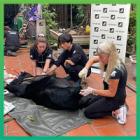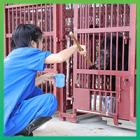


Animals Asia's Vietnam Director Tuan, Communications Advisor Leanne and Communications Officer Thuy, recently visited the Vietnam hospital where another case of bear bile poisoning was recently reported. They had an opportunity to meet both the doctor in charge and the elderly patient from Ban Ninh Province, learn the background and see the results of the patient ingesting bear bile.
The 82 year old patient had an accident in mid-September 2011, resulting in a bruised hip and lower back injury and first used a mix of dried bear bile and alcohol as a massage remedy to reduce the bruising and pain. But with no change after two days, he mixed the dried bile with water and drank about a tablespoon of the bile mixture.
Within an hour of ingesting the bile, he began to feel very hot and uncomfortable, and nothing he did could make his temperature subside. Despite cool showers, he remained intensely hot and also became aware of a red, itchy rash that had now broken out across his body, affecting his back, stomach and part of his face, legs and feet.
He was taken to a local hospital and after a week was transferred to Hanoi as there was no improvement in his condition. There, Dr Truong, of the Department of Allergy and Immunology at Bach Mai Hospital, described his condition as a serious allergic reaction to bear bile. By this time the skin on his feet was peeling off and his back was severely affected by the rash. After seven more days of treatment, he has gradually started to improve and, although the rash is still evident, his skin has stopped peeling and he is more comfortable.
In recent years, the danger of using bear bile has continually been highlighted by the medical community in both China and Vietnam. In 2008, Dr Wang Sheng Xian, a Chengdu-based Chinese pathologist, warned about the use of bear bile being harmful to people. At the same time, Dr Dang van Duong, Chief Pathologist at the Bach Mai Hospital in Hanoi said he was shocked by the condition of the bears used for bile extraction and urged consumers to think twice before taking bear bile. Click here to read the full report.
More recently, in 2010, reports of poisoning caused by bear bile surfaced and medical professionals again warned against its use — Experts warn against the use of bear bile.
Vietnam’s highest-ranking traditional medicine practitioner has repeatedly warned consumers to stop taking bear bile products or risk liver and kidney damage – even death. Dr Nguyen Xuan Huong joined Animals Asia’s campaign to end bear bile farming after seeing the shocking effects of bile consumption on some of his patients, including two government officials who died after taking bear bile tonics: Warning, bear bile tonics can kill.
Together with Chinese and Vietnamese pathologists, Animals Asia is compiling a growing dossier of evidence that the bears tapped for their bile are developing liver cancers at an alarming rate. This continues to cause concern among Asian and Western medicine practitioners about the effects of bile extracted from diseased and dying bears and they continue to argue against its usage.
The elderly patient reveals the red, irritating rash on his back that covers most of his body.
Massive skin peeling which only subsided after treatment for his allergic reaction to bear bile.